Vaginal Estrogen for Recurrent UTIs: The Underused Prevention Strategy

Written and approved by Dr. Jasmine Bonder and Dr. Adam Bonder
Introduction: The Most Impactful Intervention Many Women Never Get Offered
If you're perimenopausal, menopausal, breastfeeding, or otherwise in a lower-estrogen state, and you've been dealing with recurrent UTIs, there's a treatment that has strong evidence behind it, an excellent safety profile for most women, and can meaningfully change your quality of life: vaginal estrogen.
Multiple studies over decades have shown that vaginal estrogen can significantly reduce recurrent UTI rates in postmenopausal women, often by 50 to 80 percent. Major professional organizations recommend it as first-line prevention for this population. And yet, it remains dramatically underused in standard care, with countless women cycling through antibiotic courses year after year without ever being offered this intervention.
This guide will walk you through what vaginal estrogen is, how it works, why it's so effective for recurrent UTIs, what the safety evidence actually says (including the frequently misunderstood black box warning), what forms are available, and how to have a productive conversation with your provider about it. Our goal is to give you clear, honest information so you can make informed decisions about your care.

If you'd like a printable companion resource to bring to your next appointment, you can grab our free Clinova UTI and bladder health guide here anytime.
The Estrogen-Urinary Connection
Understanding why vaginal estrogen helps recurrent UTIs starts with understanding how deeply the urinary and vaginal tissues depend on estrogen.
Estrogen Receptors Are Everywhere
The vagina, vulva, urethra, and bladder trigone (the base of the bladder) all contain estrogen receptors. These tissues respond directly to estrogen levels, and their health depends on adequate estrogen exposure.
What Happens When Estrogen Declines
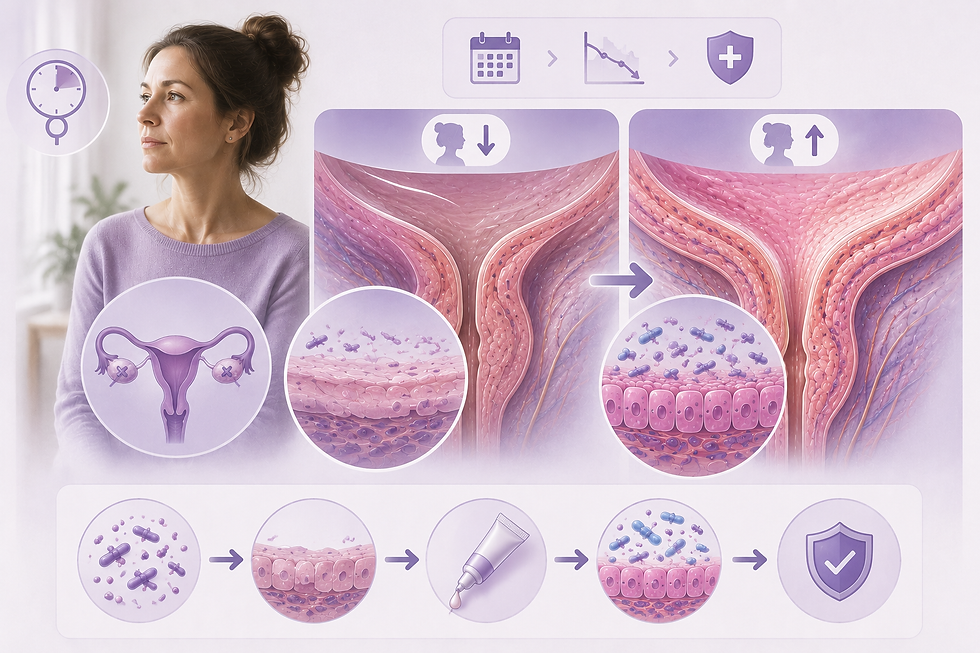
In perimenopause, menopause, breastfeeding, after surgical menopause, and in certain medical conditions or treatments, estrogen levels drop significantly. The changes that follow are collectively called genitourinary syndrome of menopause (GSM), though they can occur in any low-estrogen state, not just menopause.
Without adequate estrogen:
Vaginal tissue thins and loses elasticity
Urethral lining becomes fragile and vulnerable
Protective Lactobacillus declines in the vagina
Vaginal pH rises from acidic (3.8 to 4.5) toward neutral
E. coli colonization around the urethra increases
Blood flow to tissues decreases
Natural immune function weakens
The urinary microbiome becomes less diverse and less protective
Each of these changes independently increases recurrent UTI risk. Together, they create the perfect storm that many postmenopausal women experience: infection after infection, despite doing everything else "right."
Why Vaginal Estrogen Works So Well for Recurrent UTIs
Vaginal estrogen works by directly reversing the changes described above. It works locally on the tissues where you apply it, which is why it's so effective without significant systemic effects.
Restores Vaginal and Urethral Tissue
With regular use, vaginal estrogen:
Thickens the vaginal and urethral lining
Restores natural elasticity and moisture
Improves blood flow to the tissues
Strengthens the physical barrier to infection
Supports the Microbiome
Protective Lactobacillus returns with estrogen support
Vaginal pH drops back to healthy acidic levels
The urinary microbiome becomes more diverse and protective
Harmful bacteria have less opportunity to colonize
Reduces E. coli Colonization
Research has consistently shown that vaginal estrogen reduces the colonization of the vaginal introitus (the area around the urethral opening) by E. coli. Since most recurrent UTIs are caused by E. coli that ascends from this area, reducing colonization directly reduces infection risk.
Improves Urethral Function
Vaginal estrogen supports the urethra's natural function, including proper closure and mucosal defenses. This can also help with urinary urgency and mild leakage that often accompany GSM.
The Evidence Base
Vaginal estrogen for recurrent UTIs is one of the most well-studied interventions in this space, with consistent evidence across decades.
Landmark Studies
The evidence goes back to the early 1990s. Notable research includes:
Raz and Stamm (NEJM, 1993) — Randomized controlled trial showing vaginal estrogen significantly reduced recurrent UTI rates in postmenopausal women
Multiple subsequent randomized trials confirming the effect across different formulations
Systematic reviews and meta-analyses consistently supporting the benefit
LaClair et al. (Urology, 2026) — Recent research providing further evidence for vaginal estrogen's role in reducing recurrent UTI recurrence
Effect Size
Across the literature, vaginal estrogen typically reduces recurrent UTI rates by 50 to 80 percent in postmenopausal women, compared to placebo or no treatment. This is a large effect size for a preventive intervention, comparable to or exceeding antibiotic prophylaxis in many studies.
Professional Recommendations
Major medical societies now recommend vaginal estrogen as first-line prevention for recurrent UTIs in postmenopausal women:
The American Urological Association (AUA)
The International Urogynecological Association (IUGA)
The North American Menopause Society (NAMS)
The European Association of Urology (EAU)
The evidence and expert consensus support it. The gap is in implementation.
How Vaginal Estrogen Differs From Systemic HRT
One of the most important points, and one of the most misunderstood, is that vaginal estrogen is fundamentally different from systemic hormone replacement therapy (HRT).
Local vs. Systemic
Systemic HRT (oral pills, patches, gels applied to skin) delivers estrogen throughout the body. It affects the whole system and has broader benefits and risks.
Vaginal estrogen delivers estrogen locally to the vaginal, vulvar, urethral, and bladder trigone tissues. Systemic absorption is minimal. It essentially treats the tissue you apply it to, with very limited effect elsewhere.
Different Safety Profile
Because systemic absorption is minimal, vaginal estrogen has a significantly different safety profile than systemic HRT. This distinction matters for:
Women who can't use systemic HRT for various reasons
Some cancer survivors (with appropriate oncology guidance)
Women with certain cardiovascular considerations
Long-term use safety
The "Black Box" Warning Question
Vaginal estrogen products in the United States carry a "black box" warning that has historically discouraged use. This warning was originally required because of concerns about systemic HRT. Recently, the FDA acknowledged that this warning may not accurately reflect the risks of vaginal estrogen specifically, and discussions have continued about updating labeling to reflect current evidence.
Major medical societies and menopause specialists have long argued that the black box warning on vaginal estrogen is not supported by the evidence and creates unnecessary barriers to care. The North American Menopause Society and other organizations have published position statements clarifying this.
In practice: for most postmenopausal women without specific contraindications, vaginal estrogen is considered safe and appropriate, and the concerns behind the black box warning generally don't apply to local vaginal therapy.
Forms of Vaginal Estrogen
Vaginal estrogen comes in several forms, each with different application methods, dosing schedules, and characteristics.
Creams
Estradiol cream (Estrace)
Conjugated estrogens cream (Premarin)
Applied with an applicator
Typically nightly for 2 weeks (loading), then 2-3 times per week (maintenance)
Can be applied to specific areas as needed
Flexible dosing
Tablets/Inserts
Vagifem, Yuvafem (10 mcg estradiol tablets)
Imvexxy (softgel inserts)
Inserted vaginally with an applicator or by hand
Nightly for 2 weeks (loading), then twice weekly (maintenance)
Less messy than creams
Consistent low dose
Rings
Estring (releases about 7.5 mcg estradiol per day)
Femring (higher dose, has some systemic effects)
Inserted vaginally, worn for 90 days
Changed every 3 months
Convenient (no daily application)
Good for women who prefer less frequent dosing
Choosing a Form
The best form depends on:
Personal preference (mess factor, convenience)
Cost and insurance coverage
Individual anatomy and comfort
Provider recommendations
Response to different formulations
Some women find creams work best for specific areas of concern. Others prefer the convenience of rings or the simplicity of tablets. It's often reasonable to try different forms to find what works.
Who Benefits Most From Vaginal Estrogen
Based on the evidence, vaginal estrogen benefits several specific populations most.
Postmenopausal Women
This is the primary evidence base. Women who have completed menopause and experience recurrent UTIs benefit substantially from vaginal estrogen.
Perimenopausal Women
Women in the transition to menopause often develop urinary symptoms, recurrent infections, or GSM before their periods stop completely. Vaginal estrogen can help during this transition.
Breastfeeding Women
Breastfeeding creates a temporary low-estrogen state that can significantly affect vaginal and urinary health. Some breastfeeding women benefit from short-term vaginal estrogen while nursing, with obstetric guidance.
Women on Estrogen-Suppressing Medications
Women taking aromatase inhibitors, GnRH agonists, or other treatments that suppress estrogen (often for cancer treatment, endometriosis, or other conditions) may experience significant GSM and recurrent UTI issues. Vaginal estrogen can sometimes be used safely with oncology or specialist guidance.

Post-Surgical Menopause
Women who have had ovaries removed (oophorectomy) experience sudden estrogen loss. Vaginal estrogen can be particularly important in this population.
Premature Menopause
Women who experience menopause before age 40 have particularly extended exposure to low-estrogen states and often benefit significantly from vaginal estrogen.

If you're managing recurrent UTIs and haven't been offered vaginal estrogen, you don't have to keep navigating this alone. Visit Clinova Solutions to learn how clinician-led telehealth care can help you access this evidence-based treatment as part of comprehensive recurrent UTI care.
Safety and the Cancer Question
For many women, particularly those who've had breast cancer or family histories that concern them, the safety question is central. Here's what the current evidence actually shows.
General Safety Profile
For most women, vaginal estrogen has an excellent safety profile:
Minimal systemic absorption
Very low rates of side effects
Generally well-tolerated long-term
No convincing evidence of increased serious health risks in most populations
Endometrial Safety
There has been long-standing concern that vaginal estrogen might cause endometrial changes. Current evidence suggests:
Low-dose vaginal estrogen appears safe for the endometrium in most women
Concurrent progestin isn't typically needed (unlike systemic HRT)
Any postmenopausal bleeding should still be evaluated
Breast Cancer Considerations
This is where the conversation gets nuanced.
For women without a history of breast cancer, vaginal estrogen is generally considered safe
For women with a history of breast cancer, the picture is more complex and requires individual discussion with oncology
Many breast cancer survivors can use vaginal estrogen safely with oncology guidance, particularly those who aren't on aromatase inhibitors
Some studies suggest even women on aromatase inhibitors may be able to use very low-dose vaginal estrogen in specific circumstances
The North American Menopause Society and other organizations have position statements supporting individualized use in cancer survivors when quality of life and recurrent UTI risks are significant.
When Vaginal Estrogen May Not Be Appropriate
Undiagnosed vaginal bleeding (needs evaluation first)
Active hormone-sensitive cancer (needs oncology discussion)
Certain acute conditions
Individual sensitivities or allergies
Some women simply don't tolerate it
Most contraindications are specific and can be discussed with a knowledgeable provider.
Common Misconceptions
Several misconceptions keep women from getting the benefit of vaginal estrogen.
"It's the same as HRT pills"
No. Vaginal estrogen is a local treatment with minimal systemic absorption. It's fundamentally different from systemic hormone therapy.
"It causes breast cancer"
Evidence doesn't support this for vaginal estrogen use in most women. The concerns behind the black box warning generally reflect systemic HRT, not vaginal use.
"I can only use it short-term"
For most women, long-term use is safe and often necessary to maintain benefits. Once you stop, tissue changes typically reverse over time.
"My symptoms aren't bad enough"
Recurrent UTIs alone are enough reason to consider vaginal estrogen. You don't need to have severe dryness or pain with intercourse to benefit.
"I don't want to start hormones"
This is understandable but often based on the misconception that vaginal estrogen is similar to systemic HRT. Learning about the actual mechanism and safety profile often changes women's perspective.
"My doctor didn't mention it, so it must not be right for me"
Unfortunately, vaginal estrogen is significantly underused in primary care, often because providers may not be current on the evidence or may be overly cautious due to the black box warning. Your provider not mentioning it doesn't necessarily reflect the medical evidence.
Practical Use Guidance
If you and your provider decide vaginal estrogen is right for you, here's what to know.
Getting Started
Loading phase: Most protocols involve daily use for 2 weeks
Maintenance phase: Then reducing to 2-3 times per week
First improvements: Often noticed within 2-4 weeks
Full effects: Usually seen at 3-6 months of consistent use
Application Tips
For creams:
Apply at night before bed
Use the amount prescribed (small amounts are effective)
Can be applied to internal vaginal tissue and/or to the vulvar and urethral area
Wash hands after application
For tablets:
Use the applicator or insert manually
Insert as high as comfortable
Best done at bedtime for absorption
For rings:
Inserted by you or your provider
Wear for 90 days
Remove and replace on schedule
Doesn't need to be removed for intercourse (for most women)
What to Expect
Some initial irritation is possible as tissue adjusts
Discharge may increase temporarily
Full benefit takes weeks to months
Consistent use is key
Some women notice benefits beyond UTIs (less dryness, less urgency, better intimacy)
Common Side Effects
Mild vaginal irritation (usually settles)
Increased discharge (usually mild)
Very rarely, systemic effects
Some women have specific sensitivities to particular formulations
Cost and Access
Costs vary significantly by form and insurance coverage
Generic estradiol cream is often the most affordable option
Rings tend to be more expensive but require less frequent replacement
Some women benefit from patient assistance programs
Insurance coverage varies
Want a clear, easy-to-share resource you can bring to your next appointment? Download our free Clinova UTI and bladder health guide.
How to Talk to Your Provider
If your provider hasn't offered vaginal estrogen, or if you're not sure it's been considered:
Useful Questions to Ask
"Given my recurrent UTI history and hormonal status, would vaginal estrogen be appropriate?"
"What forms would you recommend for my situation?"
"How does the safety profile of vaginal estrogen differ from systemic HRT?"
"Are there any specific reasons I shouldn't use it?"
"How long would I need to use it?"
"What can I expect in terms of benefit and timing?"
If Your Provider Is Hesitant
Some providers are more cautious than the evidence supports, often due to concerns based on systemic HRT that don't apply to vaginal use. If this happens:
Ask specifically about their reasoning
Mention that major professional societies recommend it
Consider a second opinion from a menopause specialist or urogynecologist
Consider consulting a provider who specializes in recurrent UTI care
If Access Is a Barrier
Generic formulations are more affordable
Many providers can help navigate insurance
Compounded formulations are sometimes an option
Telehealth providers specializing in women's health can often help
When to Seek Specialized Support
Please reach out to a qualified clinician if you experience:
Recurrent UTIs in a low-estrogen life stage (perimenopause, menopause, breastfeeding, or on estrogen-suppressing medications)
Any GSM symptoms (dryness, painful intercourse, urinary urgency, vulvar irritation)
Frustration that your recurrent UTIs haven't been addressed with a comprehensive approach
Difficulty getting a provider to consider vaginal estrogen
Concerns about long-term antibiotic use for prevention
You should always seek prompt care for postmenopausal bleeding, severe pain, or signs of serious infection.
How Clinova Solutions Can Help
Clinova Solutions specializes in caring for women with recurrent UTIs, chronic urinary symptoms, and the conditions that often surround them. We understand that vaginal estrogen is one of the most impactful, underused tools in modern recurrent UTI care, and we make sure our patients have access to informed conversations about it.
Our approach is built around:
Clinician-led telehealth care so you can access expert support from home
Comprehensive evaluation that identifies hormonal factors contributing to your recurrent UTIs
Evidence-based use of vaginal estrogen when appropriate, with clear discussion of benefits and safety
Personalized plans that combine hormonal optimization with other proven strategies
An education-first philosophy that helps you truly understand your options
Judgment-free conversations about hormones, menopause, and women's health
Non-antibiotic prevention including vaginal estrogen alongside methenamine hippurate, D-mannose, and microbiome support
Coordination with your other providers for comprehensive care
You deserve care that offers you the full range of evidence-based options, including the ones that standard care often overlooks.
To take a more informed next step, you can:
Download our free UTI and bladder health guide for a clear, practical resource you can keep and share.
Visit Clinova Solutions to learn more about our care model and how we support women through every stage of urinary and vaginal health.
Frequently Asked Questions
Does vaginal estrogen really help recurrent UTIs?
Yes. Multiple randomized controlled trials over the past three decades have consistently shown that vaginal estrogen reduces recurrent UTI rates in postmenopausal women, typically by 50 to 80 percent. Major medical societies (AUA, IUGA, NAMS, EAU) recommend it as first-line prevention for this population.
How does vaginal estrogen work for recurrent UTIs?
It restores the vaginal and urethral tissue, supports protective Lactobacillus bacteria, lowers vaginal pH back to healthy levels, reduces E. coli colonization around the urethra, and improves overall urinary tract defenses. It works locally on the tissues that need it.
Is vaginal estrogen safe?
For most women, yes. The safety profile is significantly different from systemic HRT because systemic absorption is minimal. Long-term use is generally considered safe. Individual contraindications exist and should be discussed with a provider.
What about the black box warning?
The black box warning on vaginal estrogen was originally based on concerns about systemic HRT. Major medical societies and menopause experts have long argued this warning doesn't accurately reflect the risks of vaginal (local) use. In 2023, the FDA acknowledged that this warning may need updating. For most women, the concerns behind the warning don't apply to vaginal estrogen.
Can I use vaginal estrogen if I've had breast cancer?
This depends on your specific situation and requires oncology guidance. Many breast cancer survivors can use vaginal estrogen safely, particularly those not on aromatase inhibitors. Even women on aromatase inhibitors may sometimes use low-dose vaginal estrogen with careful discussion. This is an individualized decision.
What forms of vaginal estrogen are available?
Creams (Estrace, Premarin), tablets/inserts (Vagifem, Yuvafem, Imvexxy), and rings (Estring, Femring). Different forms suit different preferences and situations. Your provider can help you choose.
How long until I notice benefits?
Some improvement often begins within 2-4 weeks, but the full benefit for recurrent UTI prevention typically takes 3-6 months of consistent use. Tissue restoration is gradual.
How long do I need to use it?
For ongoing benefit, most women use vaginal estrogen indefinitely. When you stop, tissue changes typically reverse over time and the benefits diminish. Long-term use is generally safe.
Can I use vaginal estrogen while breastfeeding?
In many cases, yes, with obstetric guidance. Breastfeeding creates a low-estrogen state that can significantly affect vaginal and urinary health. Short-term or ongoing use during breastfeeding is often reasonable.
Will vaginal estrogen help with anything else?
Yes. It also helps with vaginal dryness, painful intercourse, urinary urgency, mild leakage, and other symptoms of genitourinary syndrome of menopause (GSM). The benefits extend beyond just recurrent UTI prevention.
Why hasn't my doctor mentioned this?
Vaginal estrogen is significantly underused in standard care. Reasons include outdated understanding of safety, the black box warning, lack of familiarity with current evidence, and time constraints in primary care. This underuse is one of the most well-documented gaps in women's health care.
What if I don't want to use hormones?
That's your choice. Non-hormonal options exist (methenamine hippurate, D-mannose, cranberry PACs, vaginal probiotics, bladder instillations, lifestyle interventions), and comprehensive care can combine several approaches. However, understanding that vaginal estrogen is fundamentally different from systemic HRT often changes women's perspectives.
When should I see a clinician?
Anytime your recurrent UTIs are a pattern, you're in a low-estrogen life stage, or you want to discuss vaginal estrogen and haven't been able to. Earlier evaluation often leads to easier, more effective change.
Follow Along for Ongoing Recurrent UTI Education & Support
Healing starts with understanding what's really going on in your body, and you should not have to figure it out alone.
We regularly share educational content about recurrent UTIs, bladder health, pelvic floor dysfunction, hormones, microbiome balance, prevention strategies, and evidence-informed approaches to chronic urinary symptoms across our social platforms.
Follow us for:
Recurrent UTI education
Prevention tips and symptom support
Bladder health insights
Expert-backed wellness content
New videos resources
Real conversations women are not hearing elsewhere
Facebook: Chronic UTI Care
Instagram: chronicuticare
YouTube: Chronic UTI
We’re here to help women feel informed, supported, and empowered through every stage of their healing journey.
This article is for educational purposes only and is not a substitute for individualized medical advice. Please consult a qualified clinician about your specific symptoms and health history.

Comments